
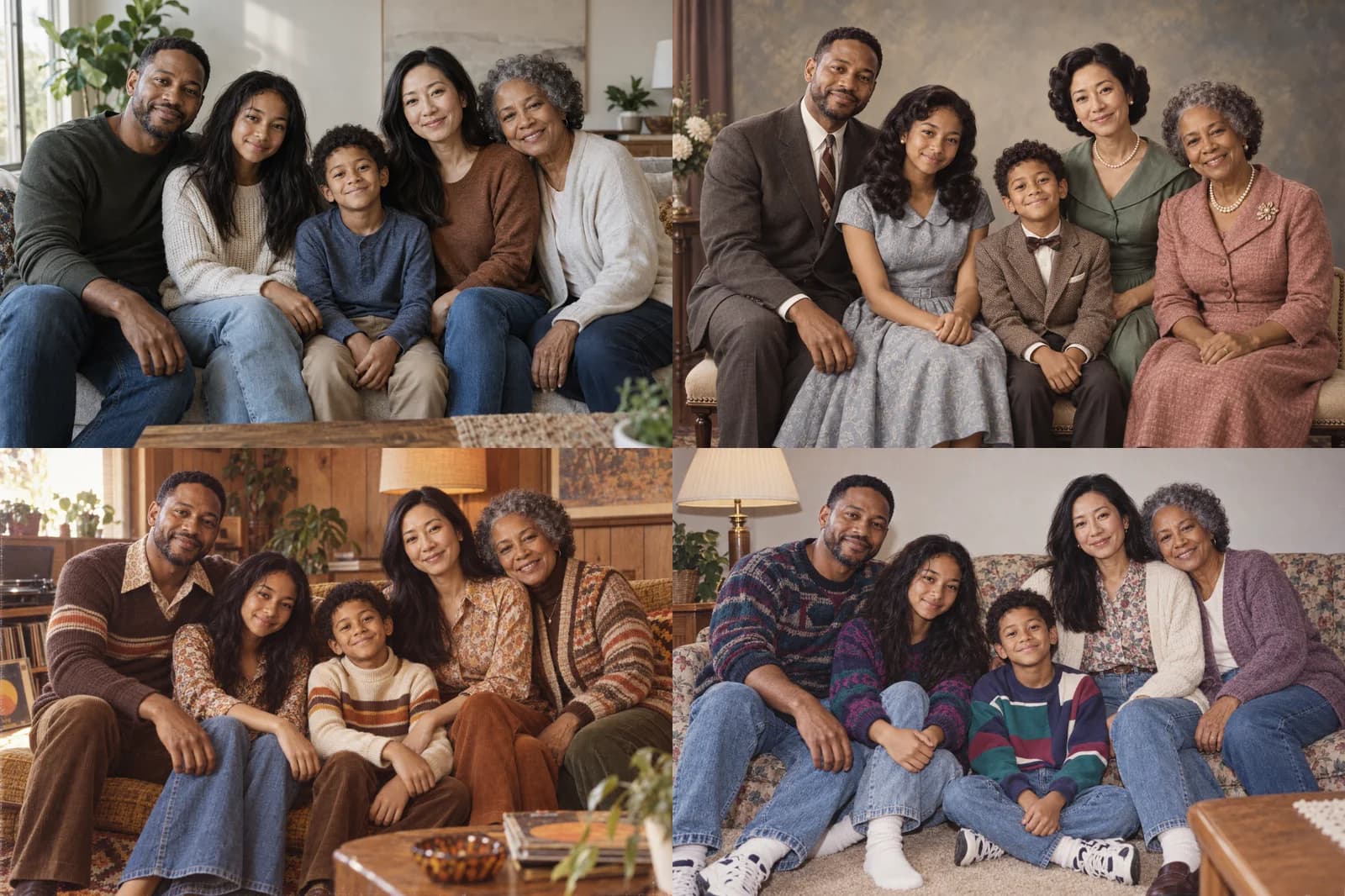
A good vintage family photoshoot begins with a decade, then asks every other choice to belong there. The pose, clothes, room, expression, light and camera character need to tell the same story. A formal 1950s studio sitting should not move like a loose 1970s snapshot. An early-1990s family-room portrait needs more than denim and a date stamp.
The images here follow one fictional five-person family through three distinct portrait traditions. The people and their relationships stay recognizable, while everything around them changes.
Begin with the family you actually have
Before choosing an era, look at how the family naturally arranges itself. Who reaches for whom? Who would rather sit on the floor? Which height differences help the group read clearly? A portrait feels warmer when it keeps one or two familiar gestures instead of forcing everyone into identical poses.
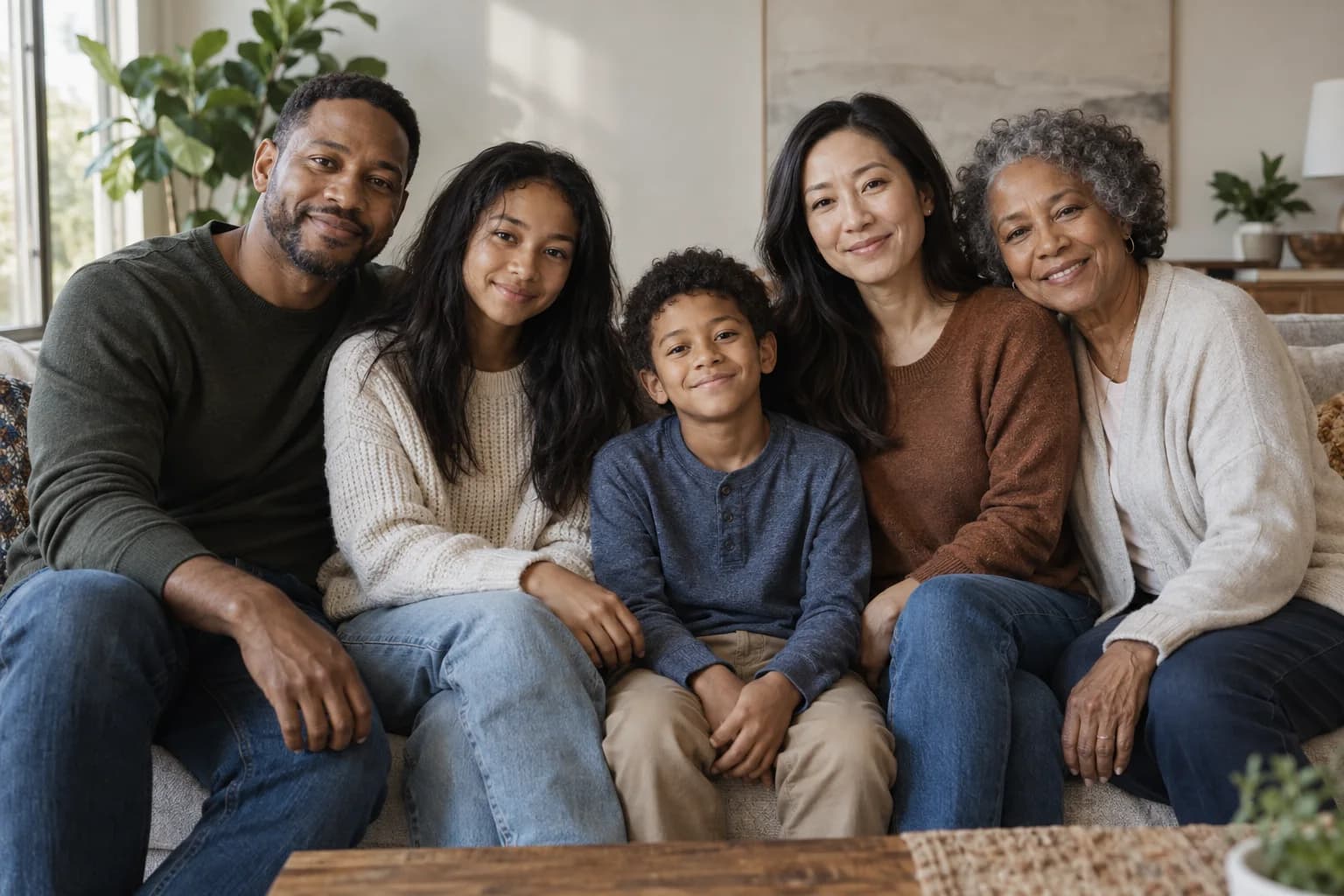
For a source photograph, give every face enough room. Avoid overlapping heads, closed eyes, deep shadows and hands crossing someone else's face. Keep the number of people fixed from the start. If five people belong in the portrait, all five should remain visible in every version.
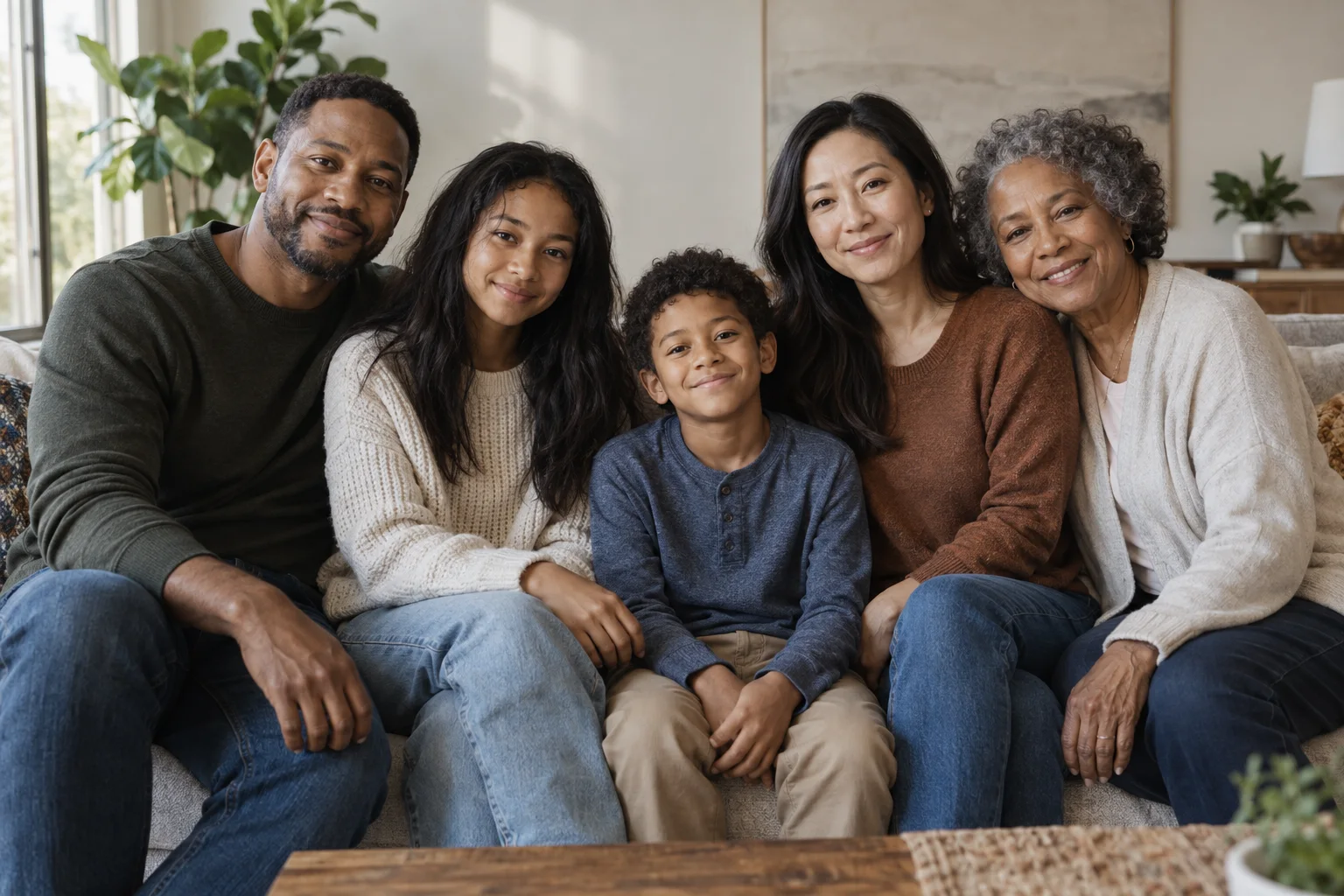
The modern source is simple on purpose: five clear faces, natural closeness and room around the group.
Throwback's AI Time Portrait can work from a multi-person source photo and reimagine the wider scene. That makes a family-through-decades idea possible, including a larger group, but it does not guarantee that every face or detail will survive every generation. Use one shared photograph with everyone's permission, and review each person before keeping a result. Open AI Time Portrait when the source is ready.
Decide what kind of vintage portrait you mean
"Vintage" can describe photographs that behave very differently. Pick one of these starting points before discussing outfits:
- a formal studio appointment, with deliberate posture and broad controlled light
- a domestic snapshot, with the room and the relationships doing much of the storytelling
- a department-store or mall portrait, neat enough for the family wall but unmistakably of its time
- a casual family-room picture, made quickly by a relative with a small camera
- a holiday or day-out photograph, where the location matters as much as the clothes
This choice settles many later questions. Formal portraits reward symmetry and careful hand placement. Domestic pictures can tolerate a crooked cushion, uneven spacing or someone looking sideways. A family wall can hold both, but each frame needs its own logic.
The 1950s: composed, close and quietly formal
For a 1950s-inspired studio portrait, build the group as one shape. Seat the children near the center, use the adults to frame them, and keep shoulders close enough that the family reads together. Hands should rest naturally on laps, chair arms or a child's shoulder. A row of stiff figures leaves no sense of relationship.
Wardrobe works best when it feels like Sunday best rather than costume hire. A textured suit, modest day dresses, pearls or a small brooch can establish the register. Hair should look set and intentional. Keep the palette restrained so the faces remain the first thing you notice.
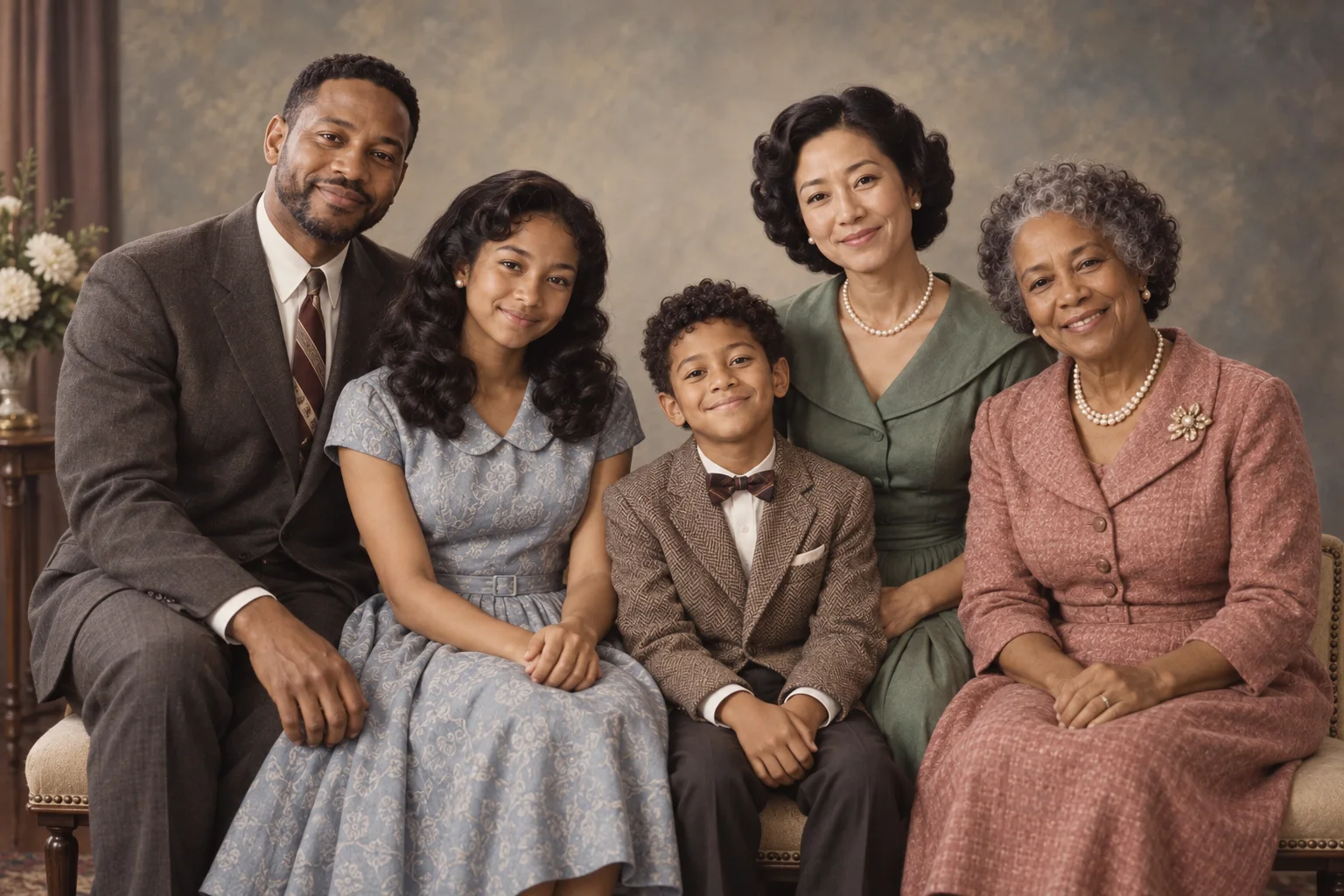
Broad studio light, a painted backdrop and a carefully joined pose make the family feel ready for a framed print.
The expressions matter as much as the clothes. Slight smiles suit the formality. If everyone performs the same wide grin, the frame starts to feel modern even when the wardrobe is correct.
The 1970s: let the room become part of the family
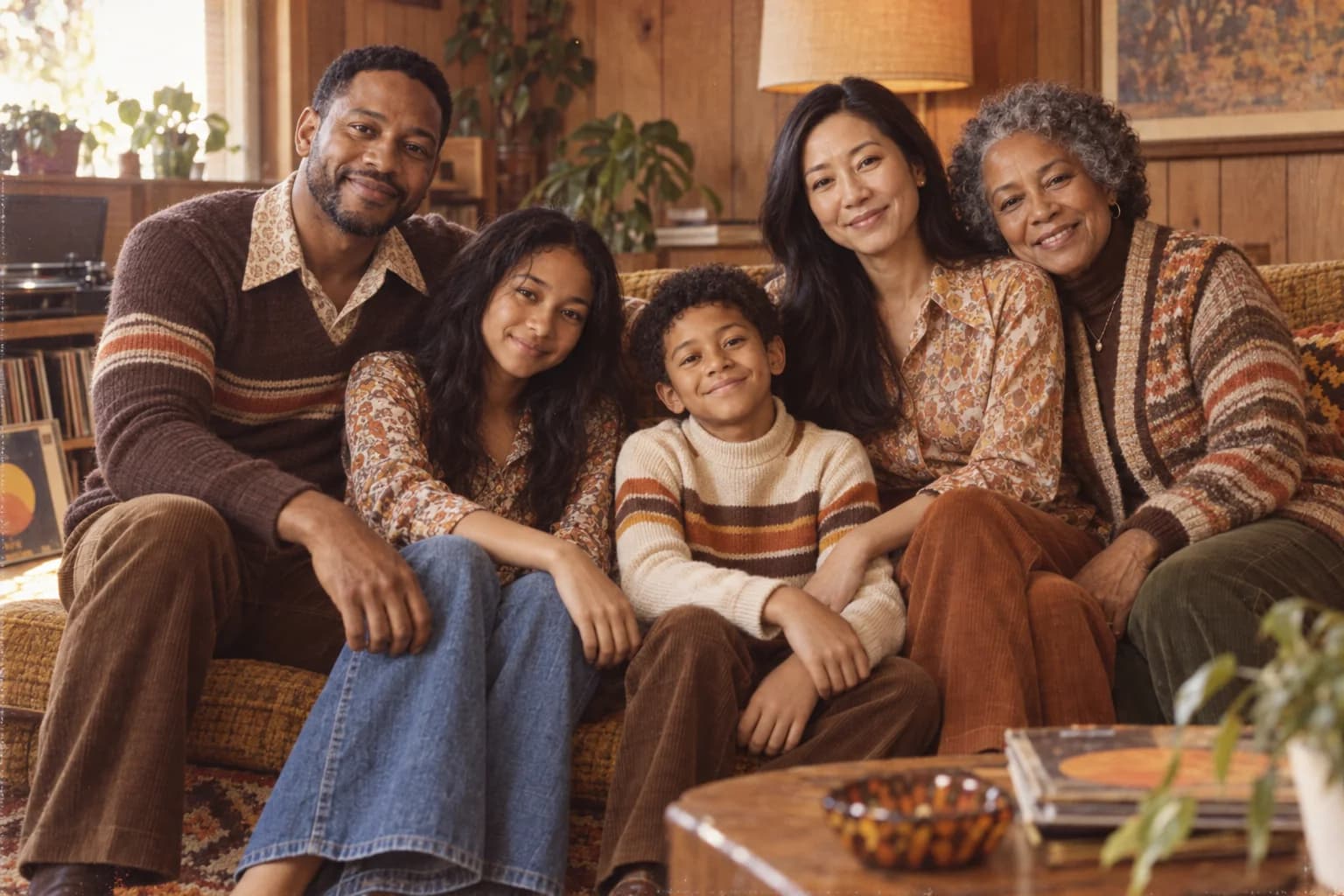
A 1970s domestic portrait can loosen the arrangement. Move away from the painted backdrop and into a family room with warm wood, a patterned sofa, records or houseplants. These details should look accumulated, not placed as labels for the decade.
Try a shallow arc rather than a straight row. Let one person lean forward and another settle into the sofa. A glance between family members can be more revealing than five faces locked on the lens, as long as no one disappears behind someone else.
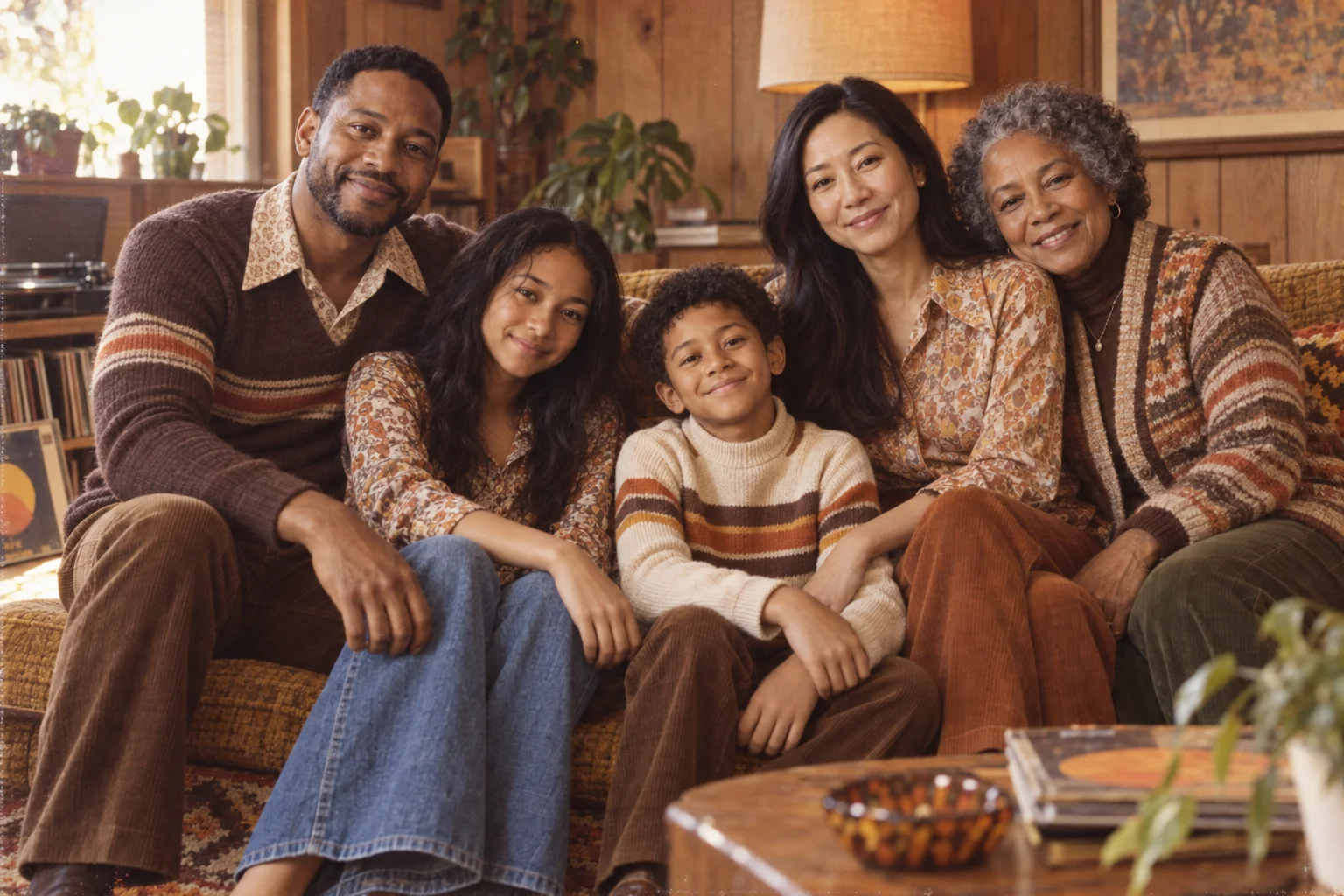
The sofa, warm room light and relaxed spacing turn the portrait into an afternoon at home.
The clothes can mix knits, wide collars, patterned fabric and corduroy, but give the group some visual rest. If every shirt carries the loudest possible print, the family vanishes into the styling. Repeating two or three warm colors across the group is enough to make separate outfits feel related.
If this is the decade that fits, start with the 1970s Time Portrait. Compare the result against the source person by person. A pleasant overall scene can hide one face that has drifted.
The early 1990s: casual, with a little structure
The familiar early-1990s family-room portrait is relaxed, but it still has structure. A floral sofa, beige carpet and direct camera flash set the scene. Denim, crewneck knits, cardigans and simple trainers can carry the period without turning the family into a theme party.
Use levels. One child can sit on the carpet while the adults and older child gather around the sofa. That breaks the lineup and keeps faces from competing for the same narrow band of space. Leave one slightly awkward detail, such as socked feet or a knee too close to the lens. Family albums are rarely immaculate.
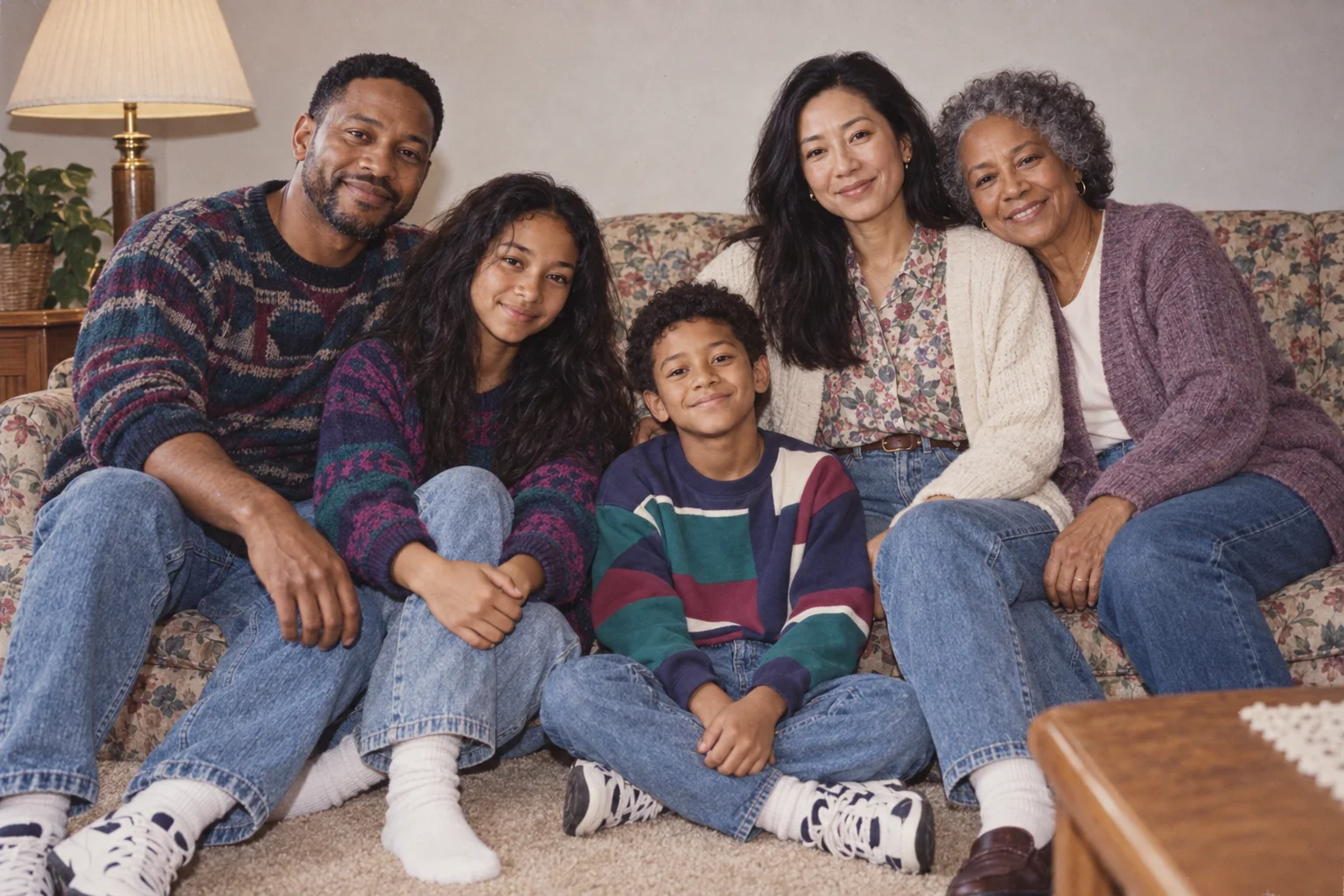
On-camera flash, floral upholstery and an informal floor-level pose make the frame feel lifted from a family album.
The photographic finish should support the scene. A little print softness and straightforward flash are useful. Heavy grain, fake light leaks and an oversized date stamp would compete with the people.
Coordinate clothes without making a uniform
Matching white shirts and identical jeans can flatten a family into one block. A better approach is to choose a narrow family of colors and let each person wear them differently. One outfit might carry the main color, another repeats it in a knit pattern, and a third picks it up in a small accessory.
Pay attention to how fabrics react to the intended light. Satin and polished shoes feel at home in a formal studio. Chunky knits and corduroy make sense in a warm domestic scene. Faded denim belongs more easily to the direct-flash 1990s frame. Historical reenactment is unnecessary. What matters is that no single choice breaks the world of the photograph.
Pose the relationships
Start with connection points. A hand on a shoulder, two heads leaning together or a child seated between adults tells the viewer how the group belongs together. Then check the practical details:
- keep faces on different levels when the group is large
- turn shoulders slightly so people fit without crowding
- give hands somewhere comfortable to rest
- leave a small gap when dark clothes or hair would merge
- take a wider safety frame before moving in close
Formal and candid are not opposites. A formal portrait can still carry affection, and a candid-looking picture still needs a readable arrangement.
Make the setting earn its place
Choose a few large cues instead of filling the room with nostalgia objects. A painted studio sweep and one upholstered bench can hold the 1950s. Wood paneling, a low sofa and warm mixed light can hold the 1970s. Floral upholstery, carpet and a floor lamp can carry the early 1990s.
Remove objects that create accidental stories. Readable labels, modern charging cables, current phones and visible screens pull the eye forward in time. So do generic prop piles. If a record player, lamp or chair does not help the composition, it does not need to be there.
Give each era its own photographic character
Wardrobe alone produces a dress-up picture. The photograph itself needs to change.
For the 1950s studio, use controlled broad light, a stable horizon and a composed frame. The 1970s room can carry warmer mixed light, gentler contrast and a little snapshot looseness. The early 1990s benefits from direct fill flash, cooler shadows and the modest softness of an album print.
Keep these choices restrained. A convincing period picture still needs believable skin, clear eyes and readable clothing. Effects should not bury the family.
Review every person before choosing the final frame
Group pictures demand a slower review than single portraits. Count the people first. Then compare each face with the source: facial proportions, eyes, nose, mouth, skin tone, age and distinguishing features. Check hands, glasses, jewelry and hairlines. Watch for a face that has drifted toward another relative, an extra hand, a merged shoulder or a child who has aged unexpectedly.
Next, review the relationships. Does the group still feel like the same family? Are the familiar height differences and gestures present? A beautiful room cannot rescue a portrait in which one person has become unrecognizable.
AI Time Portrait is a generative transformation, so it can rebuild clothes, hair, setting and photographic atmosphere. Throwback's local camera processes do something different: they preserve the original people and scene while changing its camera character. The AI transformation guide explains that boundary in more detail.
Three fully imagined eras will usually make a better set than ten lightly styled ones. Give every frame a reason to exist, and keep the same family at the center. When you have a clear source and an era in mind, take the shared photograph into AI Time Portrait and judge the result one person at a time.